


Applying Circular Economy Principles to Automotive Packaging
The Suppliers Partnership for the Environment (SP) provides a forum for global automotive manufacturers and their suppliers to work together toward a shared vision of an automotive industry with positive environmental impact.
SP’s Sustainable Packaging Work Group was established as a platform for companies from across the automotive value chain to collaborate to minimize automotive packaging waste and address barriers to packaging recyclability and/or reuse.
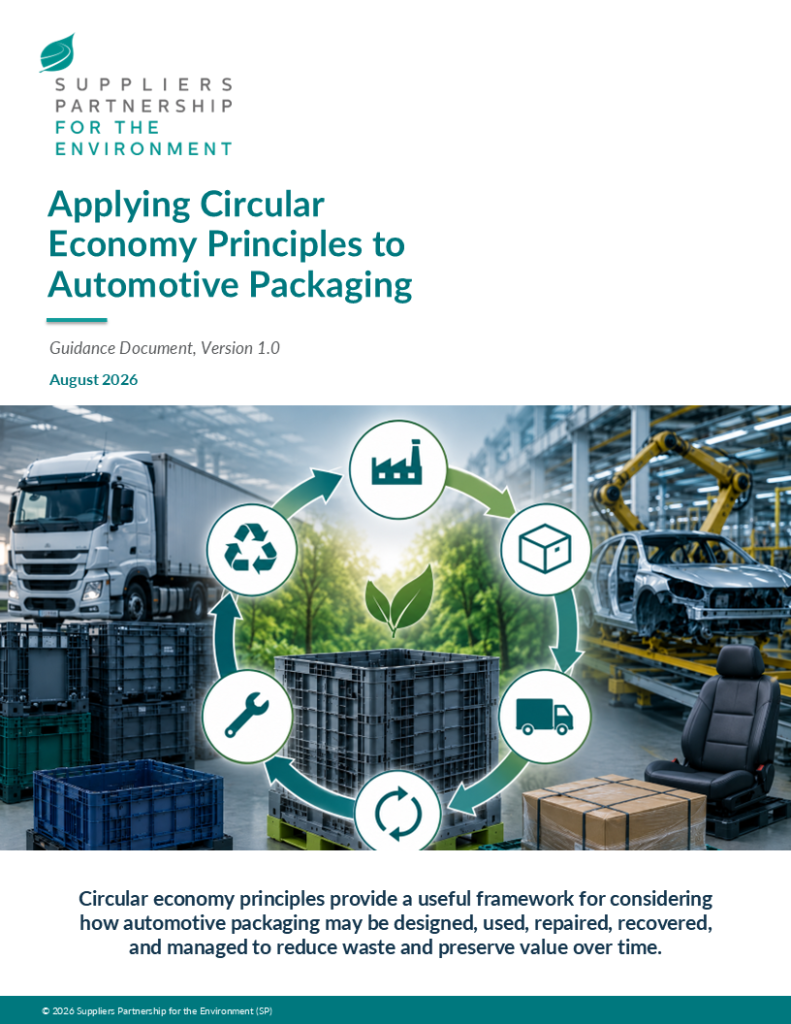
Circular economy principles provide a useful framework for considering how automotive packaging may be designed, used, recovered, and managed to reduce waste and preserve value over time. In broad terms, circular economy approaches aim to reduce waste and pollution, keep materials in use at their highest practical value, and support systems that are more regenerative by design.
This guidance is designed to provide high-level information on the application of circular economy principles within automotive packaging and to provide an accessible introduction to key concepts, considerations, and opportunity areas relevant to automotive packaging.
Applying Circular Economy Principles to Automotive Packaging
Published August 2026
This guidance document aims to provide high-level information on the application of circular economy principles within automotive packaging. It is designed to complement SP’s existing sustainable packaging resources by providing an accessible introduction to key concepts, considerations, and opportunity areas relevant to automotive packaging. Links are provided to existing resources which address many of these topics in greater detail.
Acknowledgements: This guidance document was produced through a collaborative process by members of the Suppliers Partnership for the Environment (SP) Sustainable Packaging Work Group.
Disclaimer: This document sets forth various findings based on information available to the authors at the time of issuance. These findings are not intended to set forth any industry rule, requirement or standard. Each company should independently determine its own processes and practices, including, without limitation, levels, measurements, vendors, materials, equipment, energy sources, energy use, emissions, and recyclability.
This document should not be considered to contain legal advice. SP and its member companies make no warranty, expressed or implied, regarding the accuracy or completeness of the information contained in this document, and they will not be liable for any errors or omissions in this information nor for the availability of this information. The authors of this document reserve the right to change it at any time, as they deem appropriate within their sole discretion. SP and its member companies will not be liable for any losses, injuries or damages that may result from the use of the information contained in this document. It is the sole and exclusive responsibility of every company designing and sourcing packaging materials to undertake individual, unique analysis as it pertains to their own specific application and production process, as well as to understand and comply with all applicable laws, regulations, standards, and individual customer requirements.
Contact: Please submit any feedback on this guidance or suggestions for future improvements to info@supplierspartnership.org.